Your Guide to Choosing Patterned Composite Decking

Patterned decking is becoming more popular for enriching outdoor spaces with visual interest and tonal variance. There are several ways to introduce geometric patterns; Millboard’s Modello Collection achieves a bold look effortlessly, meanwhile, more subtle designs are possible depending on how you lay the composite decking boards.
This article will explore some of the reasons to introduce patterns into your outdoor space, the benefits and possibilities of using Millboard’s solid composite decking, and some design inspiration to get your project started.
Explore our quick links:
Patterned decking makes a design statement and enhances the outdoor experience.
Patterned decking surfaces are available, such as Modello.
Explore some examples of how homeowners have used patterned decking for maximum impact.
Explore the many benefits of choosing Millboard for your decking centrepiece.
Read common queries on patterned composite decking.
Why Choose Patterned Decking?
Choosing patterned decking for your outdoor space is a sophisticated way to transform your garden into an artistic centrepiece. Whether you are planning a modest decking area or an expansive space, patterned decking adds a sense of depth, organic flow and, above all, creates a canvas for expression. You can use patterned decking and intricate laying patterns to create soft zoning for a visually distinct and functionally effective outdoor layout.
Including patterns in your composite decking design is one method to elevate the visual beauty and architectural significance of your outdoor space without compromising on usable space or practicality. Here are some reasons to consider incorporating intricate decking designs:
- Create a striking visual centrepiece
- Encourage soft zoning without obstruction or compromising usable space
- Add tonal depth and organic flow to decking areas of any size
- Allow your space to reflect your creative flair
- Create a unique entertainment space and memorable experiences
Comparing Patterned Decking Options
There are two primary methods of creating a patterned decking design: arranging the composite boards in various ways (other than parallel), or selecting our pioneering product, Modello, which, when the boards are offset, can create over 50 geometric designs.
Modello decking
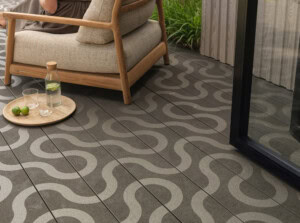
Both Modello Contour and Modello Linear offer the unique advantage of over 50 different laying patterns. The pattern on the surface of each board has been specifically designed to achieve vast design possibilities while laying the boards completely parallel to one another.
The Modello Linear boards draw on the pleasing symmetry and clean lines that we often see in geology. Meanwhile, the Modello Contour design reflects a more organic, flowing pattern reminiscent of the paths carved out by water.

Whether you prefer angular or curved patterns, there are many ways to express your creativity with the Modello Collection. See the design for yourself and order a free sample.
Decking laying patterns
A more subtle way to add intrigue and stunning geometry to your space is to create repeating patterns with the boundaries of the decking boards themselves. Some popular arrangements include chevrons, parquet, tessellating or herringbone patterns. Arranging your decking boards this way not only elevates the visual interest of your outdoor area but can also emphasise architectural elements such as firepits, dining spaces or seating areas, water features, ponds or pools.
However you envision using your composite decking, speak to your local Millboard installer or our Technical Team to discuss a custom look.
Design Ideas: How to Style
There are many ways to use patterned decking; it can be used independently to add depth and elegance to gardens, rooftops or balconies. Alternatively, you can frame architectural or landscape features, create zonal demarcations and subtle visual cues.
Timelessly stylish, a herringbone deck pattern offers subtle visual impact and lasting beauty. The space between the decking boards forms a linear geometric design interwoven with true-to-nature woodgrain detailing.
Alternatively, an intricate tessellating pattern reflects the natural repeating patterns of nature while elegantly disturbing the visual uniformity of parallel end-to-end deck boards. The natural units of a tessellating deck design can frame a fire pit while forming subtle zones between repetitions.
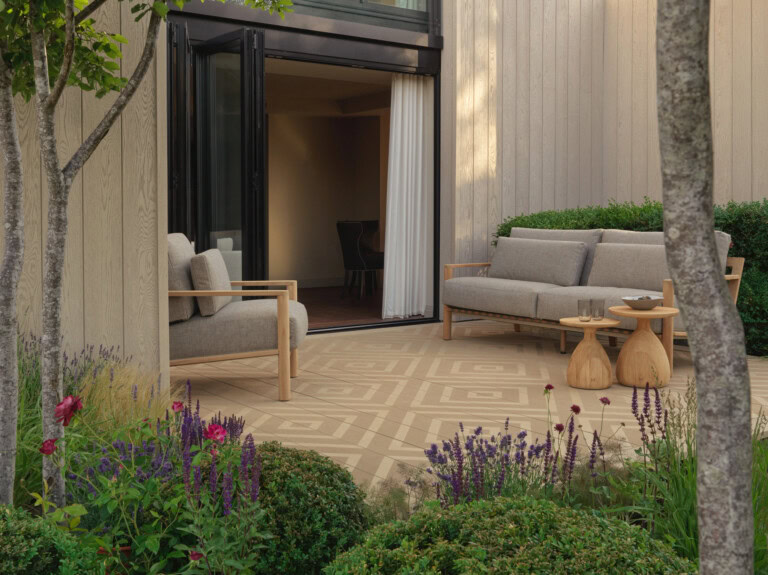
Modello decking creates its own structure. Used to segment a larger decking space, it not only creates a focal point but also reinforces soft zones without introducing physical barriers.

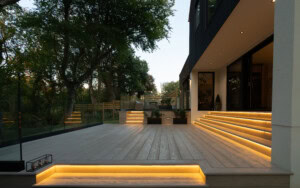
Dual-tone decking spaces create visual depth but also encourage subtle behavioural shifts. Dual-tone steps or edging creates awareness of level changes without sacrificing a refined aesthetic.
Explore more case studies for inspiration
The Benefits of Millboard Patterned Composite Decking
Often, opting for generic decking options can be a potential risk when it comes to design longevity, maintenance, performance or lifespan. The design ought to last as long as the deck itself, and its structural integrity should be uncompromising.
Achieve an awe-inspiring outdoor area with Millboard patterned decking. Modello has the advantage of being able to be offset to create over 50 design possibilities. Meanwhile, Enhanced Grain decking or Weathered Oak deliver the versatile appeal of timber and can be laid in various ways for a truly unique decking. Explore the benefits of Millboard’s resin-mineral decking below:
- Solid core composite decking is designed for durability, even in high-use spaces with heavy foot traffic.
- The Lastane® surface offers exceptional slip resistance.
- The hand-tinted surface provides a high level of resistance to UV-induced fading.
- Moisture is not easily absorbed into the boards, making them highly resistant to rotting and warping.
- The wood-free boards have low maintenance requirements.
Frequently Asked Questions
What to read next