
Shiplap Cladding vs Tongue and Groove

Click on one of the sections below to learn more:
Explore the features of one of the most popular panel systems and discover the advantages of composite material.
Compare the characteristics of the three main options to help you decide.
Discover one of the most durable exterior façades for outstanding longevity.
Benefit from the appeal of a timber-clad home with the performance of composite material.
Find answers to common questions about shiplap and composite cladding.
Shiplap is one of the most popular cladding options, but many homeowners don’t know its limitations. This article explores how shiplap compares to other types of cladding, so you can choose the right board for your project.
When watertightness, durability and longevity are concerned, there are some key differences between shiplap cladding and tongue and groove. For enduring performance, it’s essential to choose the best cladding option designed to balance aesthetic longevity and exceptional weatherproofing. Ultimately, the right type of cladding comes down to personal preference, but composite tongue and groove cladding provides many advantages over other options.
What is Shiplap Cladding?
Shiplap is a type of exterior cladding that consists of uniform, interlocking boards, similar to tongue and groove systems, except, instead of a groove, they have a characteristic scalloped profile on the upper edge and a small lip on the lower edge. This helps secure the boards over one another. The interlocking boards, combined with the bevelled edge, allow the home’s façade to be highly water-resistant when installed horizontally. However, shiplap can be more prone to water damage or ingress when installed vertically.
Shiplap panels are a fantastic option for sheds or summerhouses because they are more secure than traditional overlap cladding and offer excellent weather protection. However, they do have a looser fit than tongue and groove panels, which can be installed horizontally or vertically (depending on aesthetic preference) without compromising their integrity or water occlusion.
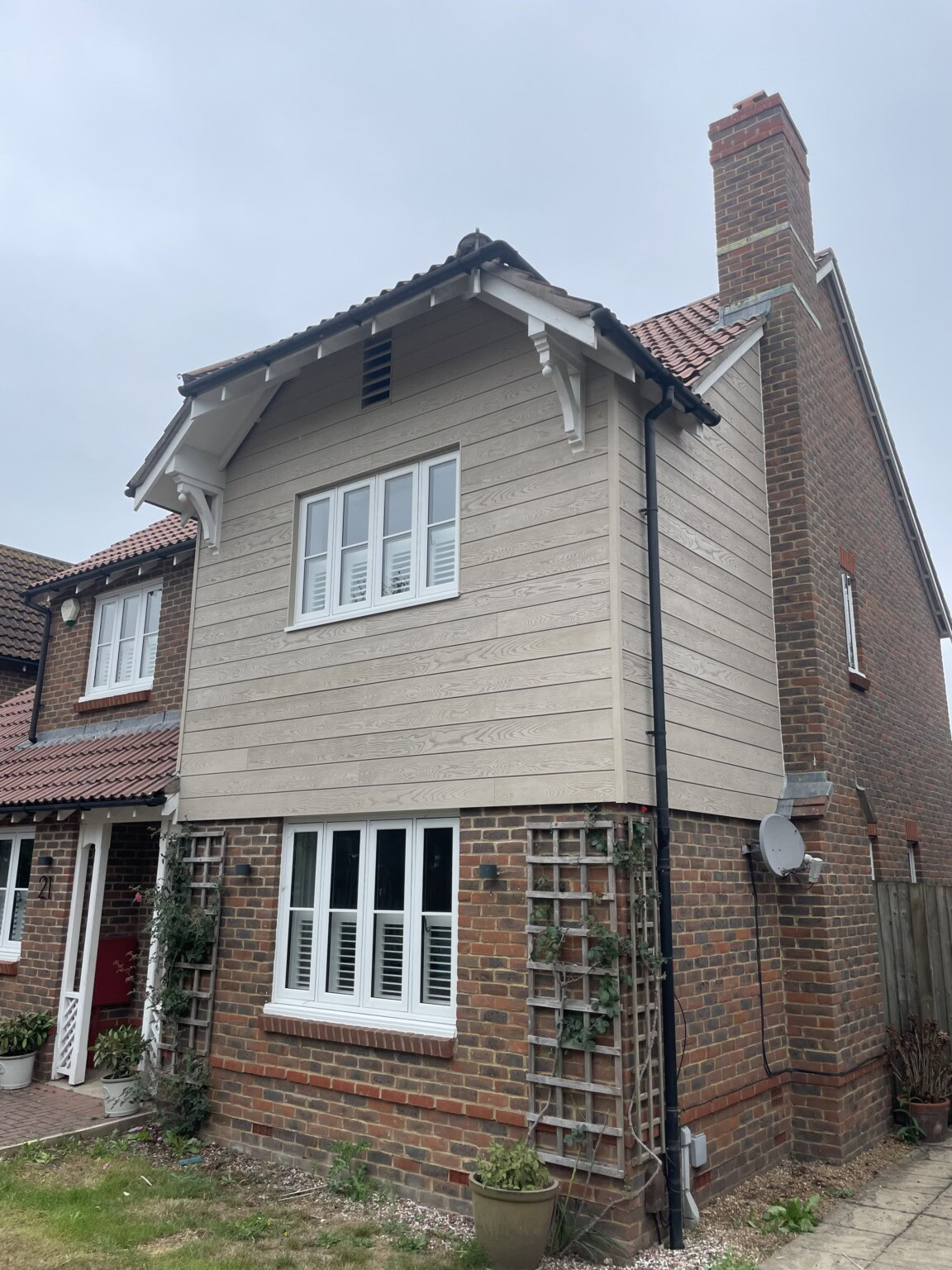
Composite cladding options are popular because they’re less prone to moisture damage, rot and decay, fading and twisting than traditional softwood cladding. Without any wood content, Millboard’s wood-free composite is an unrivalled product for exterior wall cladding.
Explore our stunning cladding case studies.
What’s the Difference Between Overlap, Shiplap & Tongue & Groove Cladding?
Most people synonymise shiplap with tongue and groove, but there are subtle differences that can really impact your home renovation project. This section explores the types of panels, including shiplap and overlap, that you should be aware of:
- Overlap: The simplest form of cladding uses flat boards that overlap horizontally to help shed water. While this approach can be fixed securely to the substructure, the boards don’t interlock, which means each piece performs independently rather than as a unified system. Because of this, it’s generally suited to straightforward horizontal applications rather than vertical installations. Over time, overlapping boards can be more prone to movement or warping, as the lack of interlocking edges offers less resistance to environmental changes.
- Shiplap: This type is a reliable option for horizontal cladding projects. Its bevelled profile creates an interlocking system that holds the boards together more securely than a simple overlap.
- Tongue & Groove: Considered the most secure option, the panels typically have a planed surface and interlocking grooves on the top and bottom, which create a uniform surface when joined together. The join is typically much tighter than shiplap or overlapping cladding, so it is a highly water-resistant option. Finally, because of the uniform profile and tight seal, the panels can be installed vertically or horizontally to suit your aesthetic preferences.
The Pros and Cons of Different Cladding Types
To gain a complete picture of the different board types, explore the comparison table below, where we dive into the pros and cons of overlapping, shiplap and tongue and groove.
| Tongue & Groove | Shiplap | Overlapping | |
|---|---|---|---|
| Pros | Creates the tightest seal against water ingress. Creates a secure exterior to withstand harsh winds. Creates a uniform profile when joined together. Can be installed horizontally or vertically without compromising performance. Available in various materials, finishes and forms. | Creates a secure exterior that’s highly resistant to water ingress when installed horizontally. Boards interlock, making them resilient in harsh weather. Modern options can offer a flat profile. Available in various materials and finishes. Often cheaper. | Budget-friendly. Offers a rustic feel. Quick to install. |
| Cons | More complex to manufacture and install, so typically comes at a more premium price. | Doesn’t perform as well when installed vertically. Entry-level options may show a bevel between the boards. The seal is not as tight as tongue and groove. The boards aren’t as secure as tongue and groove. | Timber options can warp and crack over time. Can’t be installed vertically. Isn’t watertight. Less durable against harsh weather conditions. Doesn’t offer a flat profile like tongue & groove or some shiplap options. |
Is Shiplap the Best Type of Cladding for Longevity?
While shiplap will be suitable for most exterior cladding projects, particularly if you want a horizontal installation, it’s not always the best option.
Tongue and groove cladding has many advantages over shiplap. It is designed to be installed vertically as well as horizontally, with a tight, secure joint that supports performance in demanding weather conditions.
- Vertical installations make your design options virtually endless. Tongue and groove boards enhance the design possibilities, which we demonstrate across our range of premium composite cladding.
- High resistance to moisture damage can be enhanced by using a wood-free composite façade. Explore the benefits of Millboard cladding.
- The impact and weather resistance of tongue and groove systems is strengthened by the robust resin-mineral core.
Why Choose Premium Composite Cladding
Choosing the most durable, high-performance building facing is essential for long-lasting appeal. Millboard produces stunning wood-moulded composite cladding panels. By hand-moulding the boards from selected oak masters, the intricate nuances of wood grain are preserved, while offering significant advantages over the natural material. We explore some of these below.
- Low maintenance and simple cleaning
- High impact and weather resistance
- Excellent resistance to UV-induced fading, unlike softwood
- Made using recycled content and renewable biopolymers
- Improved thermal performance and insulation
- Moisture and mould resistant
- High durability for long-term exterior use
Frequently Asked Questions
What to read next


